

Equine Sweet Dreams – Just HOW do Horses Sleep?
Posted by Jessica on 25th Aug 2023
If you’ve ever wondered how do horses sleep? The answer is: lying down AND standing up. But -there’s a bit more to it! Stay with us and we’ll fill you in with useful info—and tips how to help your horse get good, quality rest.
Horses and humans are very different in the way they sleep—and how much they need. So how many hours do horses sleep? Adult horses sleep for 3-5 hours a day, throughout the day and night—and most of that sleep happens at night. They are known as polyphasic sleepers because they get their sleep time in during multiple periods in one day (or, night)
In horses, there are four stages of vigilance: 1. awake, 2. drowsiness, 3. slow wave sleep (SWS), and 4. rapid eye movement (REM) sleep—when dreams can occur.
How does a horse sleep standing up?
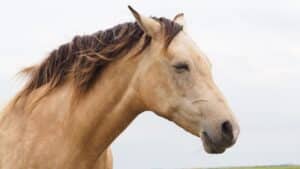
Horse sleep standing up
Horses can sleep standing up, while in SWS (slow wave sleep). In fact, most of their sleep happens while in the standing position. This is really helpful for an animal that can become a victim of prey. They have to be vigilant at all times for any threats and ready to run away quickly to safety.
Horses can sleep standing up because they have a biological feature called a stay apparatus. This is a collection of tendons and ligaments in the horse’s body that work together to keep the horse upright. This is achieved without much effort on the part of the horse.
Horses can be awake, drowsy, or in SWS while standing up. They can also be in SWS while lying on their chest, legs folded underneath.
What’s REM sleep for a horse and why does he need it?
Horses do need to lie down to complete the “rapid eye movement” or REM phase of the sleep cycle. This is a vital part of a horse’s sleep sequence, even though it only comprises about 15% of their total sleep.
How long do horses need to lay down to sleep?
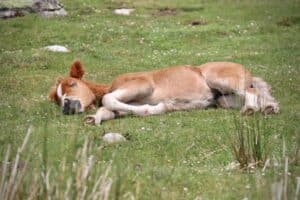
Horse laying down sleeping
This is usually only around 30 minutes per day. To complete the REM phase, horses need to lie down on their chest or abdomen, with their muzzle resting on the ground, or by lying flat on their side.
If a horse can’t lie down at all to rest for 10 days, the lack of REM sleep can cause problems. Such as, causing a horse to fall into that phase of sleep while standing. This can lead to the horse falling down and possibly injuring herself.
How long does a horse sleep lying down?
A horse can’t sleep lying down for too long. His weight applies pressure to organs, restricts blood flow to the body and compresses his lungs. It can also cause muscle weakness due to nerve damage, which can make it hard for the horse to get up and may cause further injury.
That’s why a horse only needs to lie down for about 30 minutes a day—only a small amount of the total sleep hours.
Why wouldn’t a horse lie down to sleep?
A horse may not lie down to sleep for several reasons. Many are related to stable management practices such as a too small a stall or shed or confinement in a crowded space. Other factors include dirty bedding, a noisy environment or the horse being low in the pecking order of a herd’s hierarchy. Any or all of the above may cause a horse to feel unsafe to lie down.
A horse might also avoid lying down if their joints or back are in pain, then they know it will hurt to lie down, get up or both. Moreover, they avoid lying down if they have ulcers, or even equine asthma.
How to encourage your horse to sleep better

Relaxing horse
If you can set up your horse’s environment so that he can be quiet and relaxed, he’ll be more likely to lie down for portions of his sleep time.
Make sure your horse has a clean space with deep, soft bedding at night. Consider turning lights off in the evening and reducing noise. If outside, look for areas that are manure-free and either soft sand or grass on which he can lie down.
If your horse feels threatened or bullied by other horses around him, that can prevent him from feeling safe enough to lie down. Look for a healthy herd dynamic to give your horse a good atmosphere for rest.
Additionally, if your horse feels threatened or nervous of his environment, he may choose to sleep standing so that he is ready to flee. Horses don’t seem to feel comfortable in a heavily wooded environment. This gives too much cover for any prey.
Have your veterinarian check your horse for any signs of discomfort, such as arthritis or ulcers, and take steps to reduce their pain to encourage restful sleep.
By Abigail Boatwright
Banixx Blogs
If you enjoyed this article, you can learn more about taking care of other small pets by reading another blog;such as goat care.Or if you have ever wondered about something more frivolous such asthe name of the smallest horse in the worldor, more seriously,managing your horse’s kissing spine syndrome.Or simply plan tofollowour horse blog
Moreover, if your horse ever gets anywounds,cuts.scratchesorwhite line disease, we hope you keep Banixx Horse Care in mind. We additionally have information on topics such as your horse’swolf teeth? Or, ways tohandle manure removalor the miracles ofacupuncture for your horse..yes. we’ve got these all covered for you! Need your own Banixx, clickhereto find out where to buy it!
Sources:
https://thehorse.com/1124759/horse-management-practices-sleep-quality-and-performance/
https://thehorse.com/124308/sleep-and-sleep-disorders-in-horses-aaep-2008/
https://www.petmd.com/horse/do-horses-sleep-standing
Bio: Abigail Boatwright is a lifetime horse enthusiast and award-winning writer and photographer for equine publications. She is based in Fort Worth, Texas.